What instigates shin splints?
There are many causes of shin splints yet they are generally sorted into two main groups. Overload (or training errors) and biomechanical deficiencies.
Overload (or training errors): shin splints is usually associated with sports requiring much running or weight bearing activity. However, it is not really the weight or force to the muscles and tendons of the lower leg, but rather the impact force with running and the weight bearing activity.
It is the sudden shock of repeated landings and change-of-direction that worsens the problem. When the muscles and tendons become fatigued and overloaded, they lose ability to absorb the brusque force.
Other overload causes include:
- exercising on hard surfaces like concrete
- exercising on uneven ground
- beginning an exercise after a long break
- increasing exercise intensity or duration hastily
- exercising with inadequate footwear
- excessive uphill or downhill running
Biomechanical inefficiencies: the major biomechanical inefficiency contributing to shin splints is flat feet. Flat feet results in second biomechanical inefficiencies called over-pronation. Pronation occurs just after the heel strikes the ground, the foot flattens out then rolls inward.
Over-pronation is the foot and ankle excessively rolling inward. This exorbitant inward-rolling provokes the tibia to twist, which over stretches the muscles, tendons and fascia of the lower leg.
Other biomechanical causes are:
- poor running mechanics
- tight, stiff muscles in the lower leg
- running with excessive forward or backwards lean
- landing on the balls of your foot
- running with your toes pointed outwards
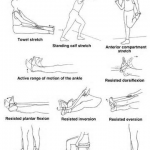
Stretches
- Calf stretch
Stretching your gastrocnemius muscle, the largest muscle in your calf, may help prevent shin splints. Stand facing a wall and step one foot in front of the other. Place your hands on the wall and lean forward, keeping the heel of your back foot flat on the floor. Hold the stretch 30 seconds, then release and repeat on your other leg.
- Standing toe-up Achilles stretch
The standing toe-up Achilles stretch is effective in preventing and treating shin splints. Stand with one foot on a step and your other foot flat on the ground. Move your front foot backward, so that the ball of your foot is resting on the step. Place your hands on your hips to balance, bend your front knee and lean slightly forward. Hold the stretch for 30 seconds, then release and repeat on the other foot.
- Kneeling stretch
The kneeling stretch helps lengthen the front of your lower leg. Kneel on the floor and place a rolled-up towel under your feet. Lower your buttocks down to rest on your calves until a gentle stretch is felt along the front of your lower legs. Rest your hands on your thighs. Hold this stretch 15 to 30 seconds, as long as pain or strain is felt.
- Heel step-downs
Heel step-downs are effective for preventing shin splints. Start with your feet shoulder-width apart. Step your right foot forward only touching the heel to the ground. Keep the ball of your foot about an inch off the floor. Return your foot back to the starting position. Perform 15 repetitions of this exercise on each foot.
- Thera-band exercise
This exercise requires a Thera-Band which can found in most sporting goods stores. Sit on the floor with your legs hip-width apart. Loop the end of the Thera-Band around the ball of your foot. Hold both ends of it in your hands. Flex your foot and rotate your ankle clockwise, then in a counterclockwise direction. Perform 15 rotations in each direction.