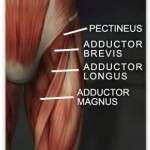
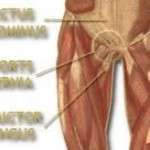
The inner thigh muscles called the ‘adductor muscle’ group, is six muscles that span from the inner pelvis to the inner femur (thigh bone). These muscles pull the legs together, and helps with the hip joint’s range-of-motion (ROM).
Overstretched or less severe strains pull groin muscle beyond normal range-of-motion (ROM).
Symptoms of a groin pull typically are sports hernias and chronic groin strains usually are related. The sports hernia is related to an inguinal hernia, muscle weakness in the abdominal wall. A sports hernia resembles a groin strain. Other symptoms resembling a groin strain are
- osteitis pubis (inflammation of the pubic bone)
- hip joint problems (including early arthritis, labral tears, and other conditions)
- low back problems (pinched nerves)
Common symptoms of a severe groin strain are difficulty walking, pain while at rest and pain at night.
An acute groin pull is severely painful. Groin pulls are normally graded one to three.
- Grade I Groin Strain is mild discomfort, with regular ROM
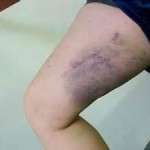
- Grade II Groin Strain is significant discomfort, that limits regular lifestyle. Usually swelling and bruising is relative
- Grade III Groin Strain is severe pain when walking. Muscle spasm, swelling, and acute bruising are collateral
A pulled groin muscle typically heals in one to two weeks, a complete tear needs up to three months after surgery and physiotherapy.
Initial treatment is the conventional RICE (rest, ice, compression, elevation) method, specially the temperature and compression to stabilize swelling and inflammation. Ice for 20 minutes, every two hours, for up to three days. Compression with a brace or wrap helps circulation, the wrap support should be two inches around the injury. When there is no pain attempt restoring range-of-motion (ROM) and walking. Also do groin muscle strengthening exercises to maintain regular flexibility and ROM of muscle. Stretch before and after physical activity.
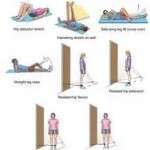
A few common ROM groin muscle rehabilitation exercises are the
- ball contraction
- side-lying hip adduction
- straight leg raise across
- resistance band adduction
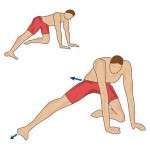
- squatting adductor stretch
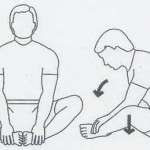
- butterfly stretch
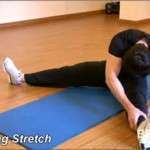
- and cross-leg stretch